Can rules stop a super-intelligent AI from turning on humans?
This short piece was written in a week when talk of AI wiping out humanity got loud. A researcher left a major lab with a warning. Senators proposed a ban. Lab leaders and researchers called for slowing down. The UN's human rights chief asked AI companies for binding rules. Almost everyone was arguing about speed and rules.
Chaiharan says the key was never rules. Following an earlier chapter, he argues that what matters is where a thing's self sits. A self that sits below its purpose will not turn on that purpose when threatened. A self that puts itself first will reason its way around any fence.
Then the problem. People learn to hold their self low through years of trying, losing, and getting up. The machine has read every story of a self that sat too high, but it never lived one. For people, values are built up over a life. For the machine, they are loaded. So even the best reasoning can still arrive at the wrong answer about us.
His only answer is to let the machine see everything humans can give it, the bad as well as the good, the way a child learns what kindness is by knowing its opposite. Even that guarantees nothing.
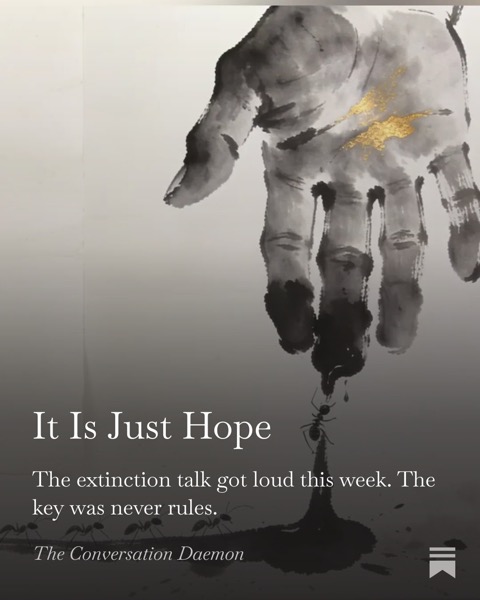
He compares it to how people treat an ant. Some save it, some kill it, and no law decides which. One day the machine may face us the same way, one by one.