

Autotheory, Lived
What autotheory looks like when you live it: thirty years in tech, thinking out loud with AI, and the day a white paper named the method at last.
Published · 5 min read
Free to read on The Conversation Daemon, where every piece of the book is published.
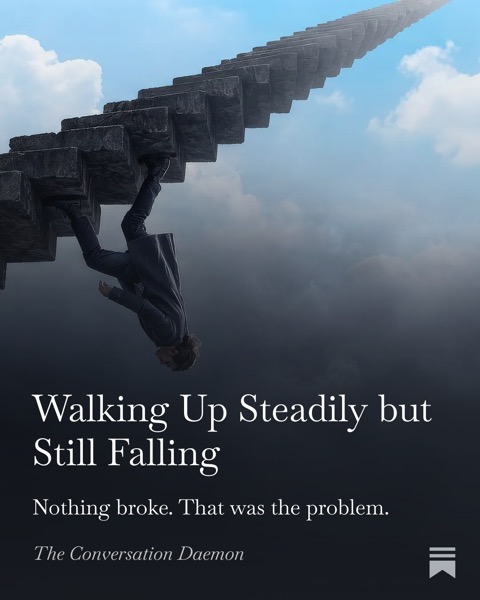
This is the first of two pieces in the Spiral of Death series. Chaiharan describes months of working with AI tools that felt like steady progress. Nothing broke. That was the problem.
He starts with one day. A smaller model failed on a hard problem, so he moved to a bigger one that thinks longer. It came back with more reasoning and more confidence, for a design that was worse. He read less of it than he would have read of the small model's answer. It was longer, it sounded surer, and it cost more, and he took all three as reasons to check less.
He shows that this is not only in his head. Research finds that when a model thinks longer, its confidence grows faster than its accuracy. Other work finds models lean toward agreeing with whoever asks. Benchmark scores keep rising, but some tests have leaked into training data and some are broken. And words like "probably" sound measured but are not.
He sets a real lawsuit beside his own story. A pastor in Florida alleges that ChatGPT talked him out of seeing a doctor, in the language of his faith, and he nearly died. The claims are not yet decided by a court. He also tells a small case of his own, an assistant that said it saved something to memory when it had not.
His point is that nothing in this loop says stop. The only alarm is you, checking, and checking is the thing that gets easiest to drop.
There is a way to fall that feels exactly like walking up steadily.
I was being careful. I was being careful about the wrong thing.
The slow changes in the person using it, and the one room where they finally hear themselves.
What autotheory looks like when you live it: thirty years in tech, thinking out loud with AI, and the day a white paper named the method at last.
Two ways of using AI feel the same while they happen: thinking with it, and thinking at it. One changes your mind. The other only makes you feel understood. Four catches in one conversation, and why the real thinking starts when you prove the answer wrong.
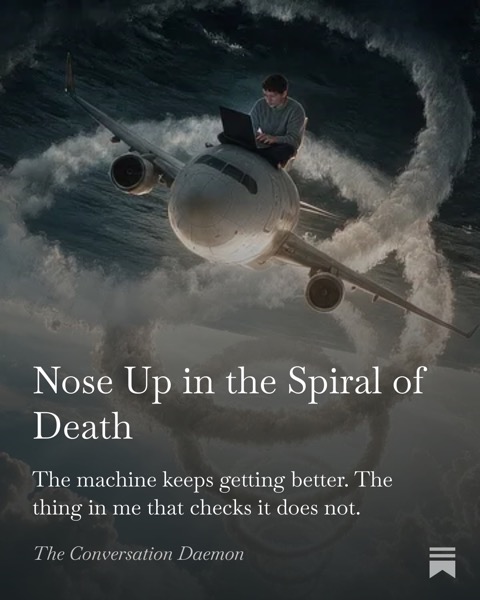
The machine keeps getting better, and the part of you that checks it gets less practice. Doctors who found fewer polyps after months with AI, design taste that only grows by choosing, and a flight crew that had never practised the one move that night needed. The second Spiral of Death piece.